
Jiangnan’s Entrepreneurial Journey
Published:
You can click the button below to listen to the full audio (about 34 minutes, in Chinese).
Between 2023 and 2024, I interviewed my father-in-law, Gan Jiangnan. This article serves as his summary of fifty years of life. It is divided into four chapters:
Chapter 1: Disabled at Age 14
Chapter 2: Starting a Business at Age 29
Chapter 3: Founding the Jiangnan Hotel at Age 44
Chapter 4: Retiring at Age 64
Key milestones in Gan Jiangnan’s life:
- September 7, 1959 (August 5 in the lunar calendar): Born in Dongsheng Village, Ganjiachang Township, Gong’an County.
- August 1973: Suffered a comminuted fracture of his right forearm.
- June 1976: Began working in Yangtze River water transport, initially selling boat tickets, later becoming captain of a small cargo ship.
- July 5, 1981: Married Chen Zhangying.
- March 1988: Left his work unit to operate Jiangnan Restaurant in Jiazhuyuan Town, Gong’an County.
- July 1993: Opened Yingong Restaurant in Douhudi Town, relocating from Jiazhuyuan Town.
- September 1997: Began operating Jiangnan Restaurant (larger venue).
- Early 2000: Founded Jiangnan Grand Hotel.
- June 2003: Began fundraising to establish Jiangnan Hotel, which officially opened on April 28, 2004.
- May 2023: Dissolved Jiangnan Hotel Limited Company, leasing the hotel to longtime employees to continue operations.
Chapter 1: Disabled at Age 14
Gan Jiangnan, born name Gan Huiwu, was born on September 7, 1959 (August 5 in the lunar calendar) in Dongsheng Village, Ganjiachang Township, Hubei Province’s Gong’an County. Gong’an County is located in southern Hubei Province, bordering Hunan Province. His parents had a child approximately every two years, ten in total, though sadly the first two died in infancy. Among the eight surviving children (four boys and four girls), Jiangnan was the second eldest. He has an older brother Gan Huiwen (also known as Gan Hainan), a younger brother Gan Huiming (also known as Gan Henan), and a youngest brother Gan Huiliang (also known as Gan Siping). His four sisters are Gan Huiying, Gan Huimei, Gan Huiju, and Gan Huirong.
With so many children and great financial pressure, compounded by their father’s gambling addiction, the entire family was crammed into a mud-brick house in Ganjiachang Township. The house was built from sun-dried mud bricks from the paddy fields. Unable to afford roof tiles, they used dried artemisia grass as roofing to block wind and rain. Every time it rained, the roof leaked, and the family could only use pots and pans to catch the water, falling asleep to the sound of wind and raindrops. Growing up in such poverty, eleven- or twelve-year-old Jiangnan developed a determination to change his family’s circumstances. He hoped to earn money through his own efforts to help the family through hard times. Back then, they rarely ate white rice—their staple foods were usually bran, sweet potatoes, peas, and shepherd’s purse (ground vegetables)—foods typically fed to pigs.
Although they lived in the countryside, Jiangnan’s family had urban household registration because his parents worked at a water transport unit in Mengjiazi Town (about 13 km north of Ganjiachang Township). At the time, the family’s income mainly depended on his parents’ wages. But money was tight, and to lighten the burden, twelve- or thirteen-year-old Jiangnan began collecting chicken and duck droppings for the village production team to use as fertilizer in exchange for some money and grain. His life was extremely hard. Every morning he had to wake up before dawn to prepare breakfast and lunch, then go to school. After school, he still had to gather firewood and cook. During middle school, most classmates brought white rice for lunch, but due to his family’s poverty, he could only bring mixed vegetable rice or eat classmates’ leftovers. He had a classmate named Lu Shengzhong who often brought white rice for lunch while Jiangnan had only vegetable rice. Sometimes they would swap—Lu Shengzhong ate the vegetable rice while Jiangnan ate white rice. Later, Lu Shengzhong’s parents found out and told him to stop exchanging with Jiangnan. After that, they could only secretly swap where no one could see. The village production team knew Jiangnan’s family was poor, so even though he wasn’t yet 14, they would sometimes call on him to join in labor, giving him opportunities to earn work points to supplement the family income.
One day in August 1973, the production team called Jiangnan to help gin cotton, and he went to work alongside the adults. The cotton gin was powered by a diesel engine, mainly used to separate picked raw cotton into seeds and fiber. This task required dozens of people working together. Jiangnan’s job was to feed raw cotton into the machine, then take out the processed cotton from the outlet and bag it. Once, after removing the ginned cotton and turning to bag it, Jiangnan stumbled on uneven ground. Losing his balance, his right hand was caught in the machine’s rotating drive belt, and his pants were torn by the gears. Those nearby shouted to shut off the machine. But it was too late—by the time the machine finally stopped, his right forearm was nearly severed, connected to his elbow only by a thin layer of skin, blood flowing continuously. Everyone was terrified by the sight.
Jiangnan passed out from the pain. After the production team gave him simple first aid, they took him to Ganjiachang Township Hospital. The doctors there said they couldn’t handle such severe injuries and recommended he transfer to a better hospital immediately. With no ambulance available, village elders carried him on a sedan chair, walking dozens of li (approximately 45 km on foot) to the Jinshi City Hospital in Hunan Province. They arrived around noon the next day. After examining his wound, doctors said both bones in his forearm had comminuted fractures and many nerves were severed. They cleaned and put a cast on Jiangnan’s wound, saying they needed to observe whether it could heal naturally.
Seven days later, when doctors removed the cast, they found the flesh on Jiangnan’s right forearm had begun to rot. The doctors suggested to his father that they amputate—completely remove the forearm and hand. His father asked his opinion, but Jiangnan adamantly refused amputation. The Jinshi hospital said they couldn’t provide further treatment. Subsequently, Jiangnan was transferred to a hospital in Changsha, Hunan Province. Doctors there also concluded amputation was necessary. Despite multiple hospitals recommending amputation, Jiangnan consistently refused. Eventually, they decided to leave Changsha hospital and return to Ganjiachang Township. This series of hospital transfers took about two months. Since Jiangnan was injured on the job, the production team covered the medical expenses at the time.
Upon discharge, Jiangnan’s forearm was still rotting, and doctors recommended changing the bandages daily to promote healing. Each bandage change was accompanied by a pungent smell of decay. Fortunately, a granduncle (his grandmother’s brother) lived near a traditional medicine doctor named Dr. Qiao who specialized in treating such injuries. This granduncle lived in An’xiang County, Hunan Province, about 40 km southeast of Ganjiachang Township. To receive treatment, Jiangnan temporarily moved in with this granduncle. Dr. Qiao believed Jiangnan’s injury wouldn’t be life-threatening—as long as he persisted with bandage changes and medication, the rotting could be controlled. He came to change Jiangnan’s medicine and bandages almost daily. Though Dr. Qiao couldn’t realign the bones, he used antibiotics to prevent further decay and cleaned out some bone fragments. Every bandage change made Jiangnan cry from the intense pain.
After about half a year of treatment at his granduncle’s home, Jiangnan learned to change his own bandages. As time passed, the rotting gradually came under control. Although the two bones in his right forearm slowly healed, his right hand didn’t recover well. Of his five fingers, only the middle finger had relatively normal blood flow; the ring and pinky fingers had limited circulation. Worst were the thumb and index finger—these two were abnormally cold, with almost no detectable blood flow.
After learning to care for his forearm wound, Jiangnan left his granduncle’s home and returned to his own. He hung his disabled right hand in gauze around his neck and returned to school to continue his studies. When he was injured, he was about to start eighth grade. During his recovery, his classmates had advanced to tenth grade (back then, middle school was two years and high school was also two years). Because he’d missed a year, Jiangnan worried he couldn’t keep up with tenth grade, so he chose to repeat eighth grade. During this time, he could only rely on his left hand. Teachers and classmates jokingly called him “One-Armed.” Since he’d been right-handed before, returning to school made it very difficult to adapt to writing with his left hand.
Although Jiangnan’s grades were average, out of sympathy, his middle school teachers helped him get into high school. During the Cultural Revolution, he didn’t learn much. In high school, he still hadn’t mastered left-handed writing and ultimately could only manage to write with his right hand. He was going through puberty at the time, and due to the injury restricting blood supply, his right arm grew somewhat shorter than his left, and his right hand was smaller.
Without completing high school, Jiangnan began formal work at age 17. His parents worked at a water transport unit in Mengjiazi Town. His father, who had attended private school for a year or two, managed the unit’s finances. His mother, who was illiterate, sold boat tickets. Ticket revenue was temporarily held by his father, then periodically turned over to the unit. At that time, people crossed tributaries along the Yangtze River using manually rowed small wooden boats. Tickets were generally 2 cents per person, rising to 3 cents in summer when the river widened. Jiangnan’s first formal job was selling tickets for crossing the Hudu River at Huangjindi (a location upstream from Ganjiachang Township).
Jiangnan’s father never did housework but had high emotional intelligence, was good at conversation, and maintained excellent relationships with unit leaders. His father loved gambling, especially mahjong and a local card game, and was often away from home, leaving all household matters to his mother. His father was once arrested for gambling and paraded through the streets wearing a tall hat. Around 1980, when water transport unit leaders audited the accounts, they discovered his father had frequently misappropriated funds, accumulating a debt of 7,000 yuan of public money. At the time, his father’s salary was about 50 yuan per month. Unable to fill the 7,000 yuan gap, his father told his children: “A father’s debt falls to his sons. I raised you all, and this money was borrowed for your sake—you must help me repay it.” Jiangnan replied: “If you hadn’t gambled, we should repay this debt. But was this money lost to gambling or spent on us? The beam is crooked, so the pillars are crooked—you didn’t set a good example!” His father flew into a rage, wanting to beat him, calling him rebellious and unfilial. This debt was ultimately repaid mostly by Jiangnan, with his older brother and eldest sister helping pay a small portion. In 1982, when Jiangnan’s eldest daughter Gan Weiwei was born, he received about 360 yuan as a bonus for registering for a one-child certificate. Jiangnan used this bonus to help repay his father’s debt.
Jiangnan felt the ticket-selling job had no future, and his disabled right hand made rowing inconvenient. He worried the unit might reduce his wages due to his disability, so he never complained to leaders about his difficulties, diligently doing his job well. This experience trained him to solve problems on his own rather than complaining to family and friends. Later, Jiangnan discovered that operating motorized cargo ships mainly relied on steering skills—even though his right hand wasn’t as strong as his left, it was more than adequate for steering. So he ultimately chose to pilot motorboats, transporting goods up and down the Yangtze River, including sand, rocks, coal, and grain.
As an adult, most young women who knew about Jiangnan’s situation shunned him for his disabled hand, unwilling to date him. At 19, he was introduced to a girlfriend from the countryside. But being too poor, Jiangnan couldn’t afford gifts for her family or make any gestures during holidays like Dragon Boat Festival or Mid-Autumn Festival. This relationship eventually fizzled out.
In 1979, Jiangnan met Chen Zhangying, three years his junior. Zhangying was not yet 17, with a pretty face, also from Ganjiachang Township. She had just been recruited as a worker at Gong’an County Knitting Factory, obtaining an urban household registration. Jiangnan was upfront about his arm disability and pursued her vigorously. He was particularly satisfied with Zhangying’s appearance and her urban registration. After about two years of dating, they registered their marriage on July 5, 1981. Before the wedding, there was a small episode. Zhangying was still hesitating about whether to marry Jiangnan. Jiangnan once told her: “If you don’t want to marry me, that’s fine. But you need to repay what I’ve spent on you—you can’t deceive me. If you deceive me, I’ll use dynamite to take us both out.” Eventually, Zhangying agreed to marry. Due to financial difficulties, they had no wedding ceremony, no house, and besides the clothes on their backs, not even a change of clothes.
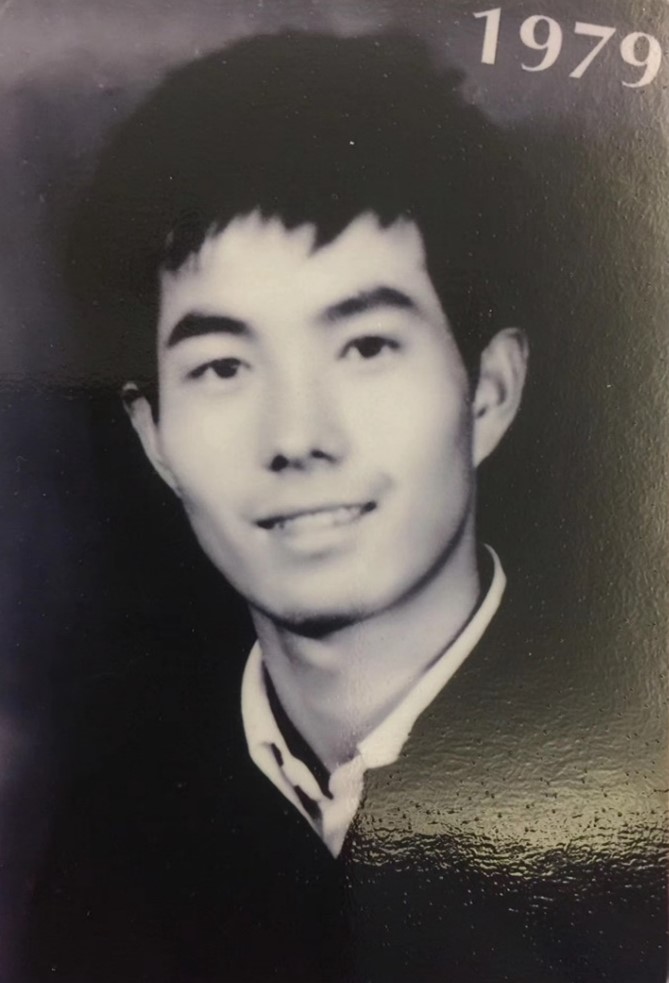
Gan Jiangnan in 1979
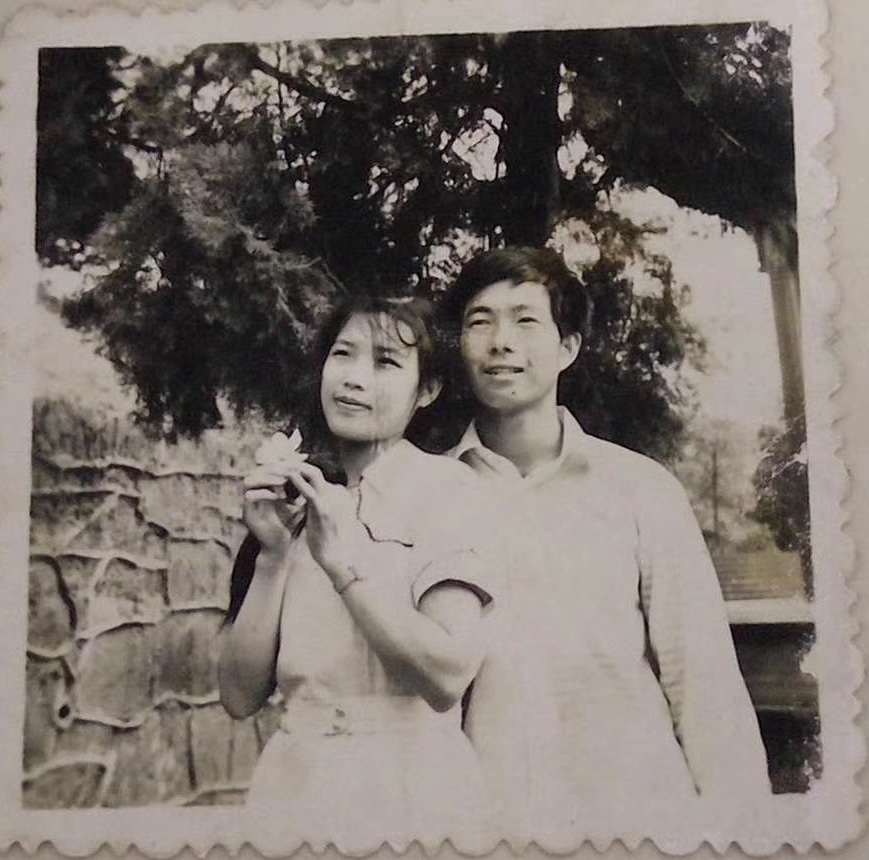
Gan Jiangnan and Chen Zhangying around 1980
Jiangnan was handsome in his youth and articulate. He showed great respect to every elder, addressing them as uncle or aunt, and these elders were willing to give him hauling business. For example, when the unit’s fleet needed to deliver goods to Shanghai, Jiangnan would network upon arriving in Shanghai to secure new return cargo orders. Networking meant buying gifts like glutinous rice, sesame oil, and sugar for the uncles and aunts in charge, asking if there was other business. Jiangnan would have the unit reimburse these networking expenses. Without these return orders, they would have to return empty. With this extra business, the fleet could earn some extra income, shared among all crew members. At that time, Mengjiazi Town Water Transport had three fleets, each accounting separately under a “more work, more pay” principle. Jiangnan’s strong work ability created much profit for his fleet. However, this also drew some colleagues’ suspicion. Some gossiped behind his back, saying his reimbursement receipts were fake. This hurt Jiangnan deeply. Later, Mengjiazi Town Water Transport adjusted their reward model, stopping reimbursements for networking expenses and the practice of sharing extra income among all crew. They introduced a new incentive system: any employee who created extra profits for the fleet would receive 2% of those profits as a reward. Thus, Jiangnan’s income situation became more transparent. From then on, questions and criticism about him never appeared again.
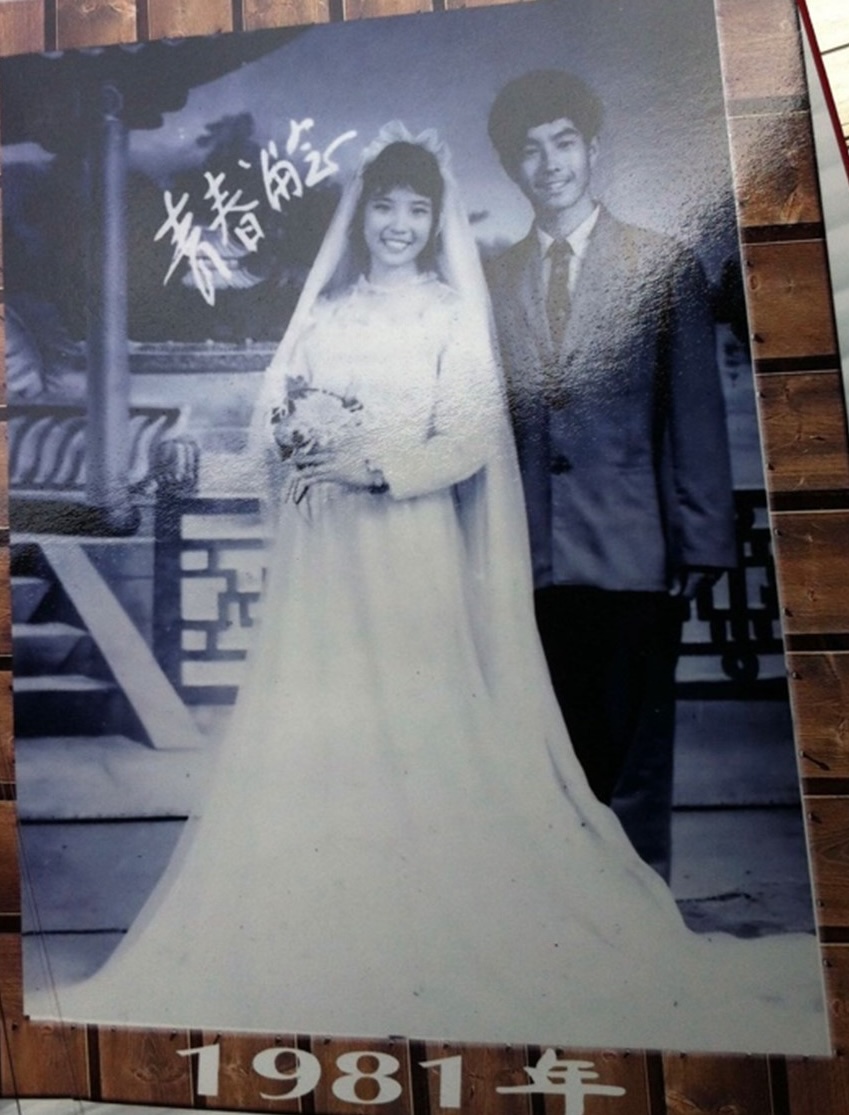
Wedding Photo, 1981
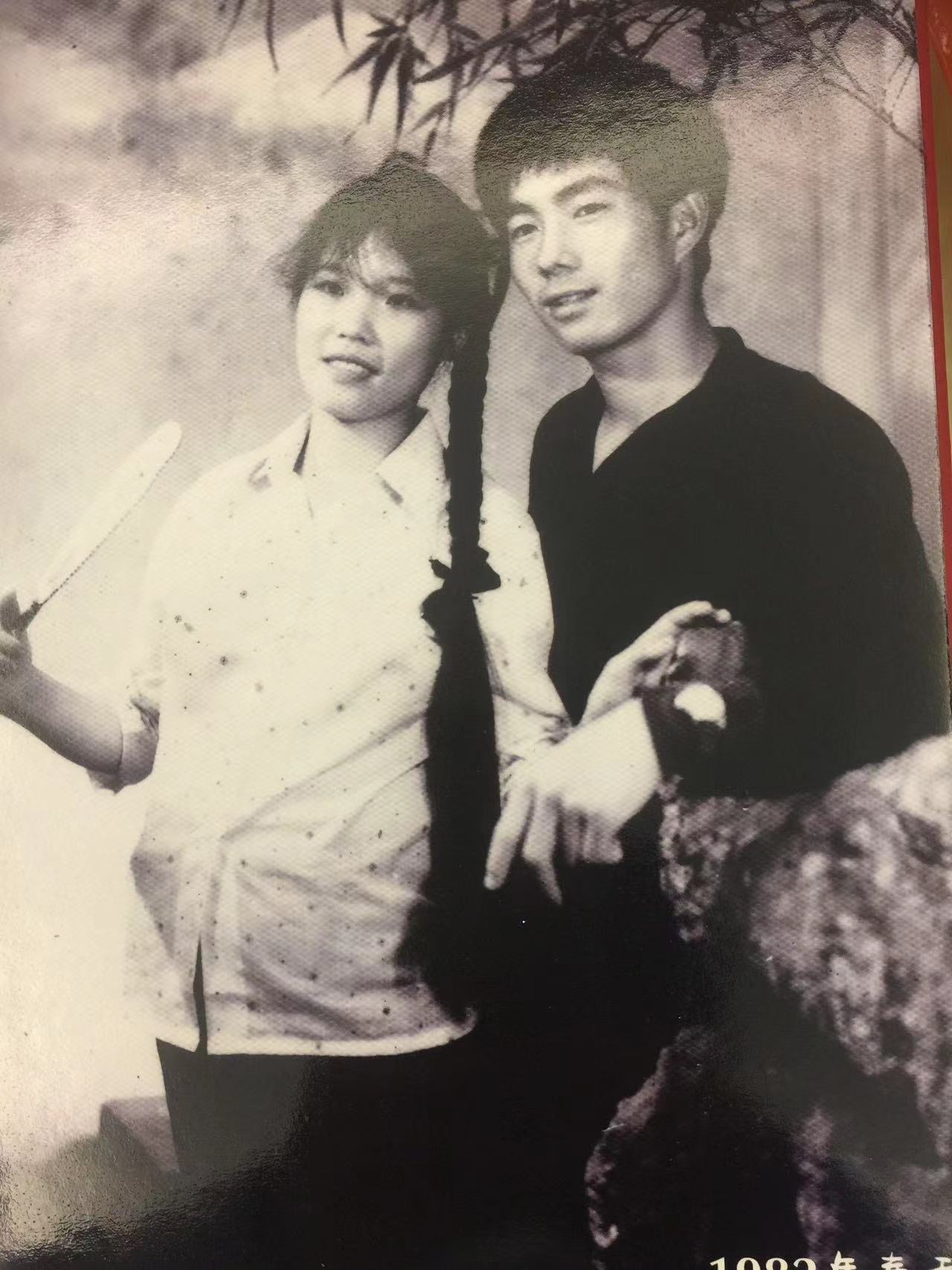
Chen Zhangying Pregnant with Eldest Daughter Gan Weiwei, 1982
After the unit restructured, Jiangnan continued cargo transport work on the Yangtze River with relatively stable income. However, since he was away navigating for long periods—each trip could last one to three months with only two or three days at home each return—he had almost no time with his wife and daughters. Before marriage, Zhangying had quit her knitting factory job. On August 18, 1982 (June 29 lunar calendar), daughter Gan Weiwei was born. To keep the family together, Zhangying decided to bring the child and live with Jiangnan on the boat. Jiangnan handled steering, while Zhangying cooked for the crew and cared for their young daughter. When their daughter was about two, Zhangying became pregnant again. On August 6, 1985 (June 20 lunar calendar), younger daughter Gan Pingping was born. After the second daughter was born, the couple had to leave their nearly three-year-old eldest daughter with grandparents while keeping the infant on the boat. To prevent the young daughter from wandering around or falling into the Yangtze and drowning, Zhangying would tie her to the boat when busy. The younger daughter was frail and frequently sick, and seeing doctors on the boat was inconvenient. This forced Zhangying to bring the child ashore, returning to Mengjiazi Town for careful care. As a result, the family of four was scattered across three locations, rarely together, making life extremely difficult.
Jiangnan knew that prolonged separation would negatively affect the entire family, so he constantly thought about how to change this situation. He longed for the family to live together. By 1988, such an opportunity finally arrived.
Chapter 2: Starting a Business at Age 29
In the second half of 1987, Jiangnan’s eldest sister Gan Huiying suggested he open a restaurant in Jiazhuyuan Town. She had a storefront there that she’d been renting out as a restaurant with good business. She thought renting to someone else was less worthwhile than renting to her second brother. Knowing Jiangnan was tight on cash, she offered not to collect rent initially—they could discuss it after the business got going.
At the time, Mengjiazi Town Water Transport Company had allocated a unit-owned apartment to Jiangnan, providing him a place to settle. If he and his wife left the unit to open a restaurant, they would have to return this apartment. After discussing with his wife, they decided to try the restaurant business, agreeing not to blame each other regardless of the outcome. So the family moved from Mengjiazi Town to Jiazhuyuan Town, about 20 km north, starting a new life. His sister’s store had two floors—the first floor for the restaurant, the second floor as living space. At the time, Jiangnan had about 5,000 yuan in assets for preparing the restaurant opening. By March 1988 when Jiangnan Restaurant officially opened, he was down to only 500 yuan.
First Family Portrait with Three Generations, Spring 1989
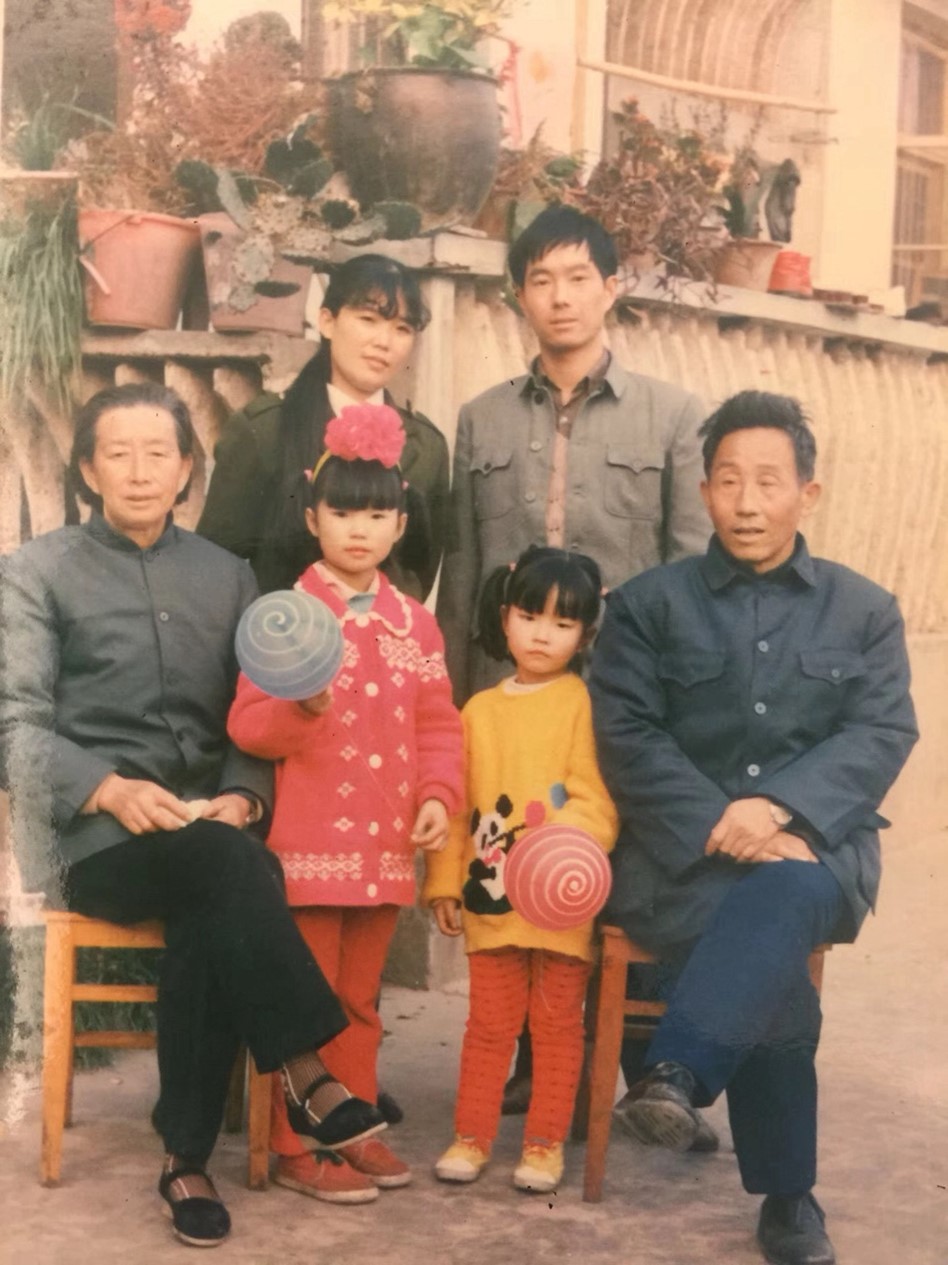
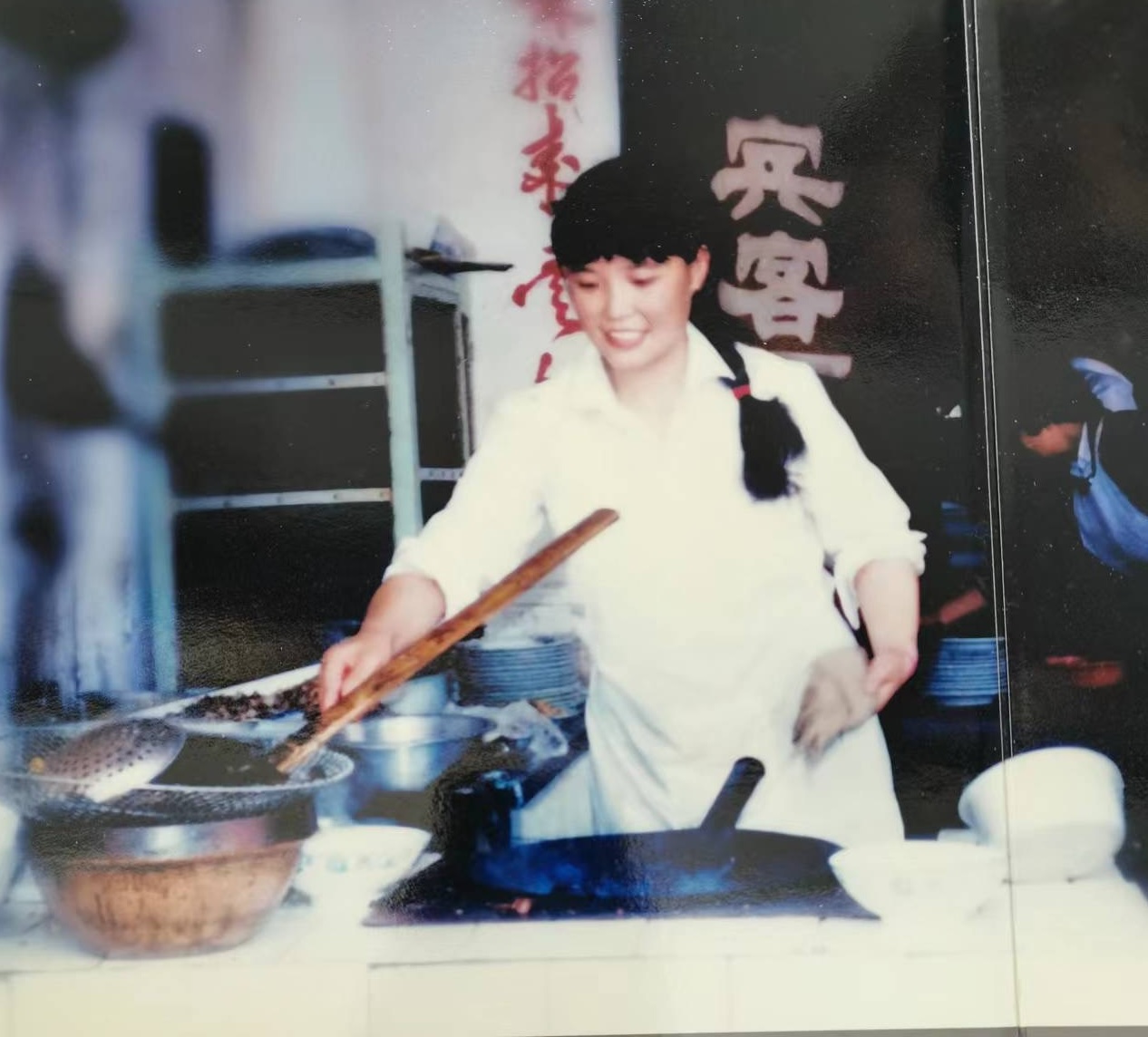
At the start, Jiangnan couldn’t cook himself due to his right-hand disability, so he hired a chef at 350 yuan per month. Zhangying learned cooking by observing and assisting this chef. The restaurant did well initially, but business declined as the government promoted anti-corruption measures. Facing poor business, Zhangying suggested cutting costs by firing the chef and taking over that role herself. They eventually put this suggestion into practice. From 1988 to 1993, Jiangnan Restaurant earned about 20,000 yuan in profit annually. By August 1993, Jiangnan had accumulated 90,000 yuan in wealth.
Chen Zhangying Cooking at Jiangnan Restaurant, 1990
After moving to Jiazhuyuan Town, the family of four was finally reunited. To ensure eldest daughter Gan Weiwei received a better education, Jiangnan specifically hired a tutor to come to their home and help her study after school. Meanwhile, Jiangnan realized that Jiazhuyuan Town, as a small township, had limited development prospects. He decided to shift his focus to Douhudi Town, the county seat about 18 km northeast of Jiazhuyuan Town. Not only was the restaurant market larger there, but the schools also offered better education quality. To gradually develop in Douhudi Town, Jiangnan invested 50,000 yuan to purchase a new apartment under construction.
Chapter 3: Founding the Jiangnan Hotel at Age 44
Douhudi Town was only a half-hour drive from Jiazhuyuan Town. One day, leaders from Gong’an County Printing Factory visited Jiazhuyuan Town on business and dined at Jiangnan Restaurant. They were full of praise for the food and asked if Jiangnan and his wife were interested in taking over Yingong Restaurant on Wujiu Road in Douhudi Town. This restaurant was in a street-facing storefront belonging to the printing factory, located on Wujiu Road—the busiest street in Douhudi Town. Directly across from the printing factory were the Finance Bureau and Tax Bureau, two major departments that would likely provide plenty of customers.
Jiangnan was excited and went to Douhudi Town early the next morning to inspect this restaurant. He learned that the previous operator had withdrawn due to losses, and the printing factory was looking for a new contractor. The restaurant had two storefronts, larger overall than Jiangnan Restaurant in Jiazhuyuan Town, with an excellent location.
Jiangnan wanted to take over Yingong Restaurant but was short on funds, so he could only pay the deposit for the contract. To raise the remaining money, he sought help from elder Gan Yongqiang (whom Jiangnan respectfully called “Second Grandfather”), showing him the contract with the printing factory and hoping for financial support. Gan Yongqiang found Jiangnan very reliable and helped him borrow 50,000 yuan at the prevailing interest rate.
During this transition period, Jiangnan frequently traveled between Douhudi Town and Jiazhuyuan Town. On one hand, he needed to supervise construction progress of his residence and renovation of Yingong Restaurant in Douhudi Town; on the other, he was handling the sublease of Jiangnan Restaurant in Jiazhuyuan Town.
After successfully taking over Yingong Restaurant, Jiangnan smoothly relocated his restaurant business to Douhudi Town, Gong’an County. Since opening in July 1993, Yingong Restaurant’s business flourished. With years of cooking experience, Zhangying mastered Hunan and Sichuan cuisine techniques, leading the team through daily operations while creating many new dishes based on local flavors. These signature dishes made Yingong Restaurant locally famous. Customers streamed in continuously, sometimes so numerous they needed to use the printing factory’s corridor space for bicycle parking. Fortunately, thanks to the printing factory leaders’ support, factory employees were quite accommodating of the restaurant’s operations.
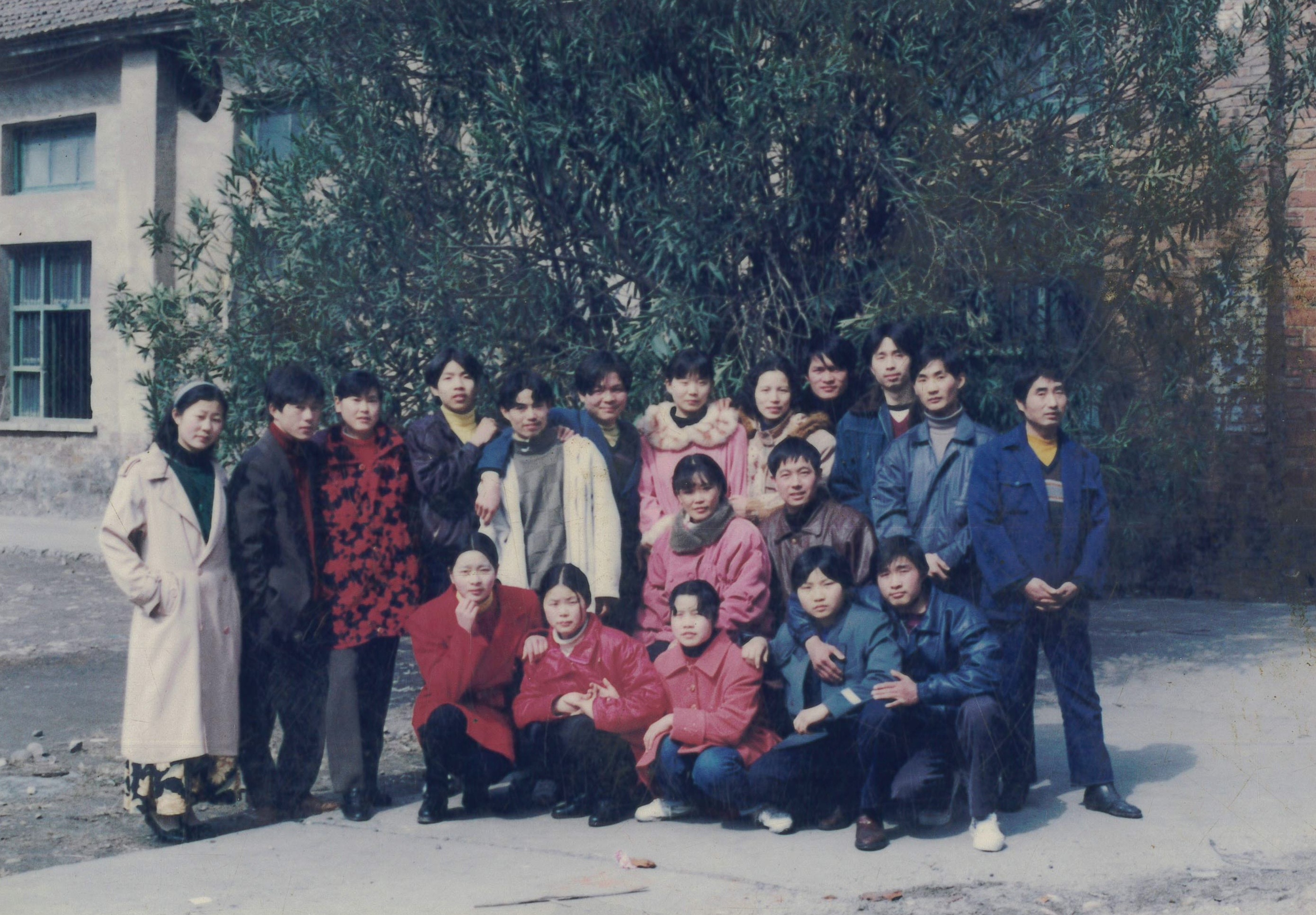
Staff Photo at Yingong Restaurant, Chinese New Year 1995
Jiangnan learned that the best elementary school in Douhudi Town was the Experimental Elementary School, so through fellow townsman Gu Shaohai’s help, he transferred Weiwei and Pingping there. This meant the two children had moved from Mengjiazi Town to Jiazhuyuan Town, then to Douhudi Town for school. They started at Experimental Elementary School in September 1993—Weiwei in fifth grade, Pingping in second grade.
Yingong Restaurant had especially thriving business in its first two years. However, as competition intensified with new openings like Yangchun Grand Hotel, Sanxing Grand Hotel, and other small restaurants, they gradually lost many customers. By late 1995, business had significantly declined, and Jiangnan decided to sublease Yingong Restaurant and take some time off. By the time he ended operations, Jiangnan had accumulated 400,000 yuan.
Around 1994, Jiangnan met Director Huang Fengming from Gong’an County Housing Reform Office. To make the children’s schooling more convenient and improve their living environment, with Director Huang’s help, Jiangnan purchased a four-bedroom, two-living-room apartment in Gong’an County Party School for 100,000 yuan. In 1996, Jiangnan sold their previous old house for 75,000 yuan. From 1996, they lived in this new Party School apartment until 2010.
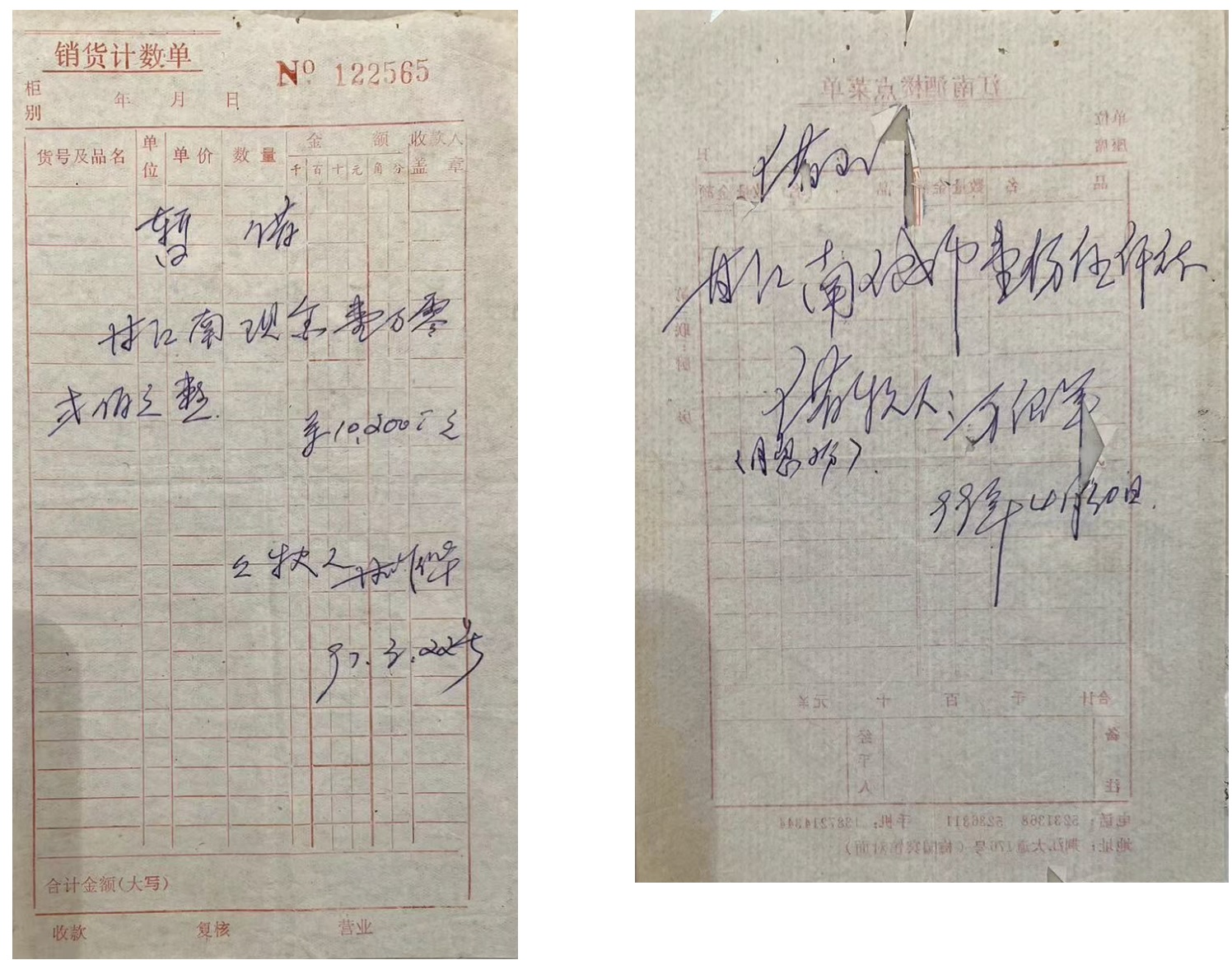
For most of 1996, Jiangnan and his wife Zhangying tried entering the clothing sales industry, but being unfamiliar with the field, they didn’t make money. During the same period, oscillating exercise machines were very popular, and Jiangnan also tried selling them. He didn’t realize at the time that the oscillating machine marketing model was actually a pyramid scheme, and again didn’t make money. Additionally, since Jiangnan had some cash on hand, relatives and friends often borrowed from him. During this period, the 100,000 yuan he lent out was never recovered. These experiences made him reluctant to lend money to others afterward.
Two IOUs from 1997 and 1999, Loans Still Unpaid
From August 1996 to July 1997, Jiangnan and Zhangying returned to the restaurant industry, taking over a restaurant at the intersection of Wujiu Road and Youjiang Road in Douhudi Town, renaming it Jiangnan Restaurant. This restaurant had an excellent location, and during their brief year of operation, business was good and they made some money. Unfortunately, the restaurant couldn’t continue because the unit that owned the storefront wanted it back. Furthermore, the newly renovated doors, windows, and tiles inside couldn’t be taken along, meaning their renovation investment was completely wasted. Overall, that year’s operation just broke even.
Three Streets in Douhudi Town and Restaurants Jiangnan Operated
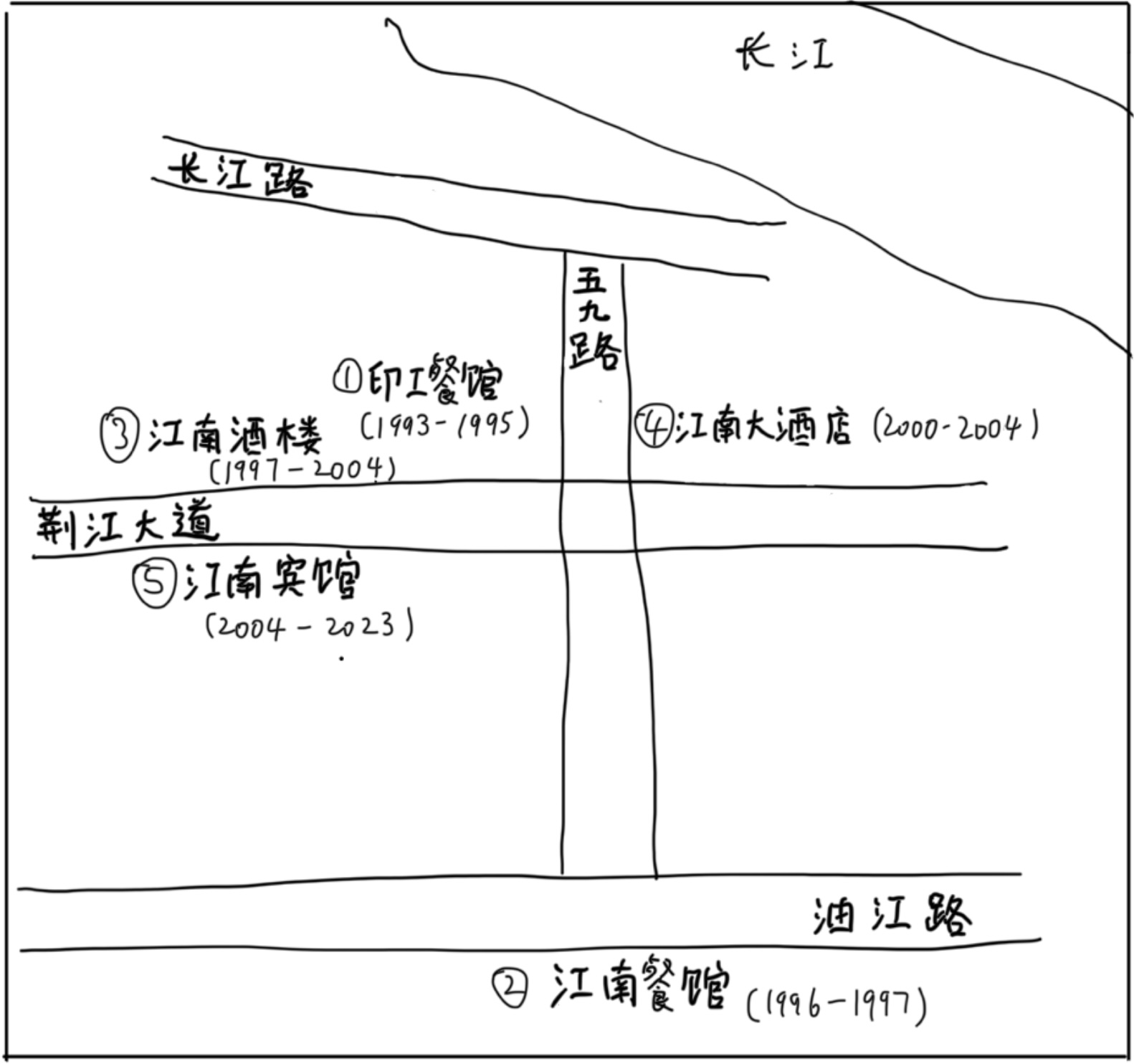
At this point, Jiangnan learned that Guangyuan Restaurant, under Gong’an County Seed Company, had closed due to poor management. He decided to take it over for 135,000 yuan and renamed it Jiangnan Restaurant. He then borrowed money for renovations. The transfer fee plus renovation cost a total of 300,000 yuan. In August 1997, Jiangnan Restaurant officially opened and quickly attracted numerous customers, with thriving business. The following year, 1998, Jiangnan recovered his entire investment.
At the end of 1999, Jiangnan met Director Yi from Gong’an County Commercial Bureau, whose daughter was classmates with Jiangnan’s eldest daughter Weiwei. Director Yi told Jiangnan that the dining department of Chanling Hotel, operated by their unit, was struggling and asked if he was interested in taking over. Chanling Hotel’s dining department was located in the core area of Wujiu Road. In early 2000, Jiangnan invested 600,000 yuan to take over Chanling Hotel’s dining department, renaming it Jiangnan Grand Hotel.
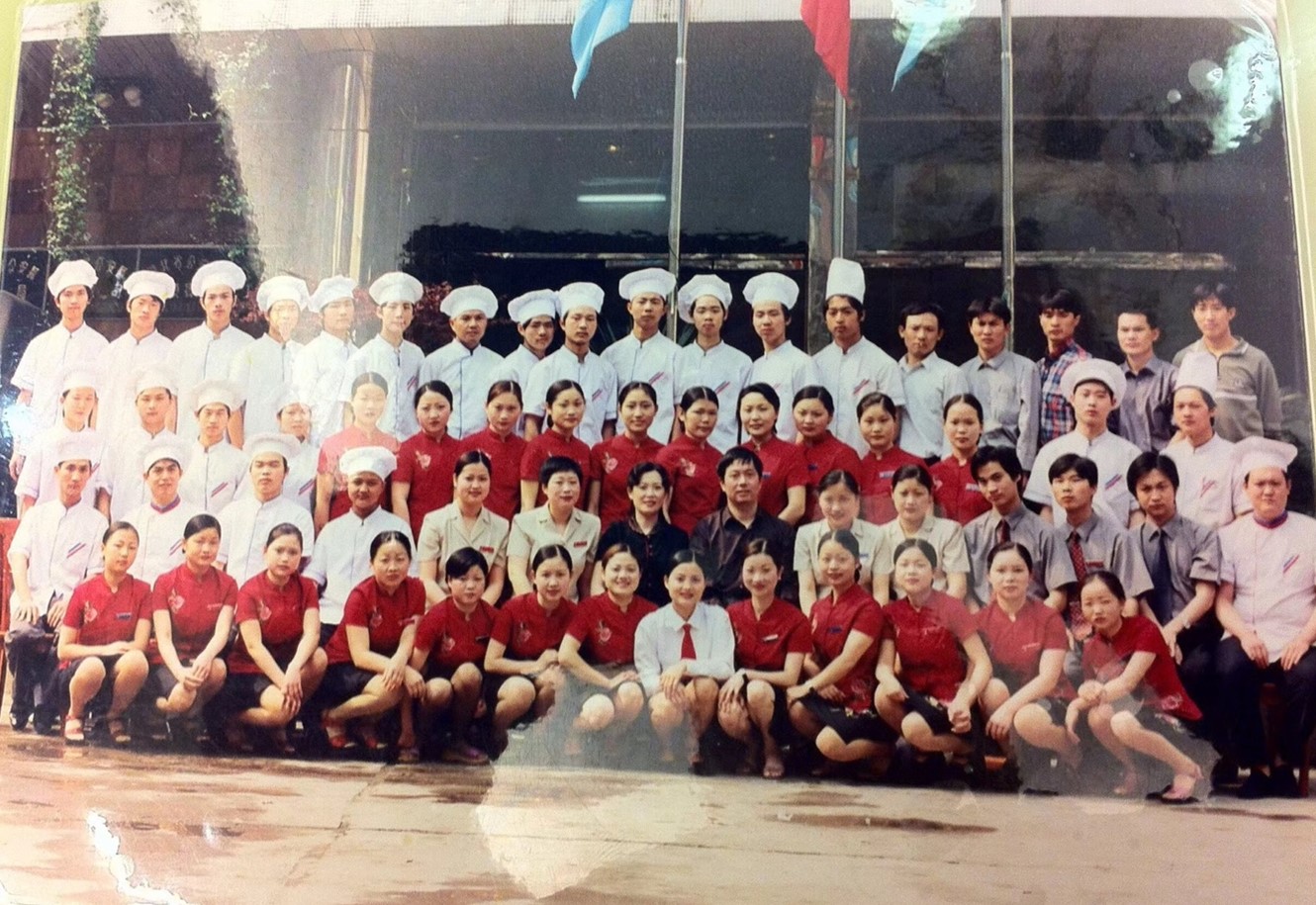
As days passed, the restaurants Jiangnan operated grew in scale: Yingong Restaurant opening in 1993 could seat 9 tables; Jiangnan Restaurant opening in 1997 could seat 20-30 tables; Jiangnan Grand Hotel opening in 2000 could seat over 50 tables. From 2000 to 2004, Jiangnan simultaneously operated both Jiangnan Restaurant and Jiangnan Grand Hotel, together accommodating over 80 tables of diners. During this period, annual profits were about 800,000 yuan. By 2003, Jiangnan’s cash reserves had reached approximately 3 million yuan.
Group Photo with All Employees of Jiangnan Restaurant and Jiangnan Grand Hotel, 2001
In 2003, Jiangnan encountered a new opportunity. The agricultural school under Gong’an County Agricultural Bureau had undergone restructuring, and the school’s land was sold to a developer named Han Shaoqiang. This developer planned to build a six-story building on the land and was looking for investors to purchase it. Meanwhile, Jiangnan was also considering buying land to build his own restaurant. For years, he had faced the predicament of renting spaces for restaurants: landlords would significantly raise rent at renewal time because business was good, or various reasons would prevent renewal, causing high renovation expenses to be lost. He longed to own the land and property rights for his own restaurant, no longer subject to others’ control. The agricultural school was located on Gong’an County’s Jingjiang Avenue, directly across from the Jiangnan Restaurant he was then operating.
Purchase negotiations with Han Shaoqiang progressed gradually. Jiangnan invited the experienced Huang Fengming to participate in negotiations. At the time, Jiangnan had 3 million yuan in cash plus 1 million yuan in receivables, about 4 million yuan available for investment. In initial negotiations, this money was only enough to purchase two first-floor storefronts (as the new restaurant’s entrance) plus the second and third floors for dining space. Han Shaoqiang originally planned to build floors four through six as condominiums to sell to other buyers. However, they considered that future residents of the upper condominiums would likely complain about cooking fumes and noise from the restaurant below. Through persistent efforts by Jiangnan and Huang Fengming, they convinced Han Shaoqiang to sell all four first-floor storefronts plus floors two through six to Jiangnan. They wanted four storefronts mainly because they planned to renovate three as the hotel lobby, with the remaining one designed as a vehicle passageway to the office building, kitchen, and employee dormitory in the back. Jiangnan saw this building’s potential—making it Jiangnan Hotel would elevate its status, not only accommodating over 80 tables but also providing 34 guest rooms. By Jiangnan’s calculations, establishing Jiangnan Hotel would require investing up to 10.8 million yuan. However, his 4 million yuan was still 6.8 million yuan short of this target. He realized he must find other funding sources to complete this transaction and achieve his plan.
To raise the needed funds, Jiangnan began soliciting investments from private individuals, promising to return principal and interest after generating profits. He promised potential investors 15% annual interest. If losses occurred, he would bear all risks himself. Additionally, he clearly stated in contracts that Jiangnan Hotel’s property and land rights belonged to him as the legal representative. Through this method, Jiangnan successfully raised about 3.45 million yuan, but still had a 3.35 million yuan gap from the 10.8 million target.
Meanwhile, Jiangnan was actively seeking commercial loans. Initially, Gong’an County Rural Credit Cooperative agreed to lend him 3 million yuan but ultimately approved only 2 million yuan. This news was very disappointing because without this 1.35 million yuan, he couldn’t reach his investment target. During Jiangnan Hotel’s construction, many facilities required funding, including transformers, power equipment, generators, non-tower water supply systems, as well as renovations and furnishing with curtains, air conditioners, and more.
Due to insufficient funds, Jiangnan Hotel opened without an elevator. After acquiring adequate funds later, an elevator was added. Because the elevator was added later, its floor settings didn’t perfectly correspond to the hotel’s actual floors. The elevator’s fifth-floor stop was actually between the hotel’s fifth and sixth floors, requiring guests to walk up or down a few stairs to reach their destination floor.
Gan Jiangnan’s Record of Some Fixed Assets for Jiangnan Hotel, 2004
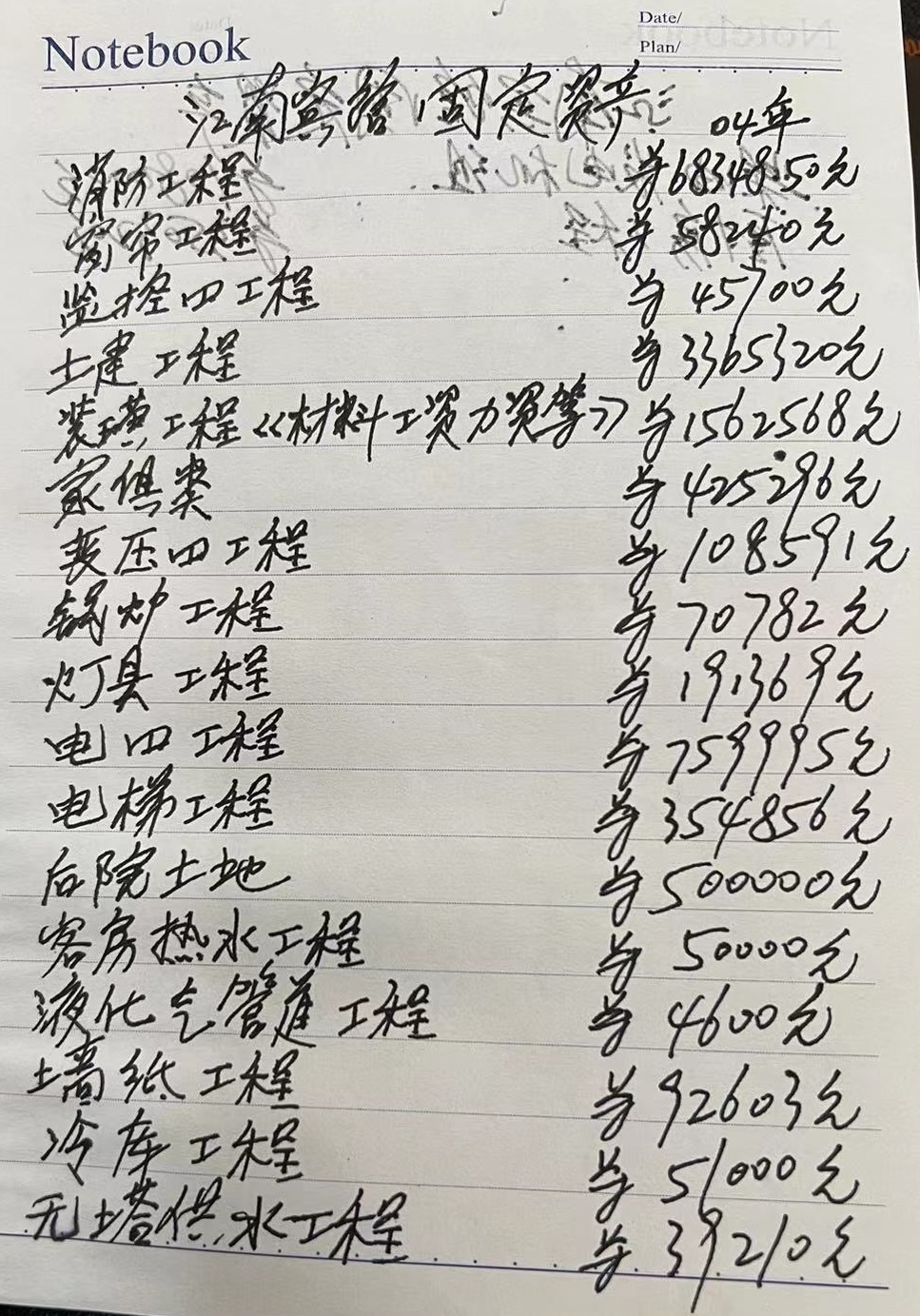
Jiangnan Hotel successfully opened on April 28, 2004, and Jiangnan Hotel Limited Company was established. To fill the final 1.35 million yuan funding gap, Jiangnan borrowed 550,000 yuan at high interest rates (some loans even at 20% annual interest) and owed suppliers 800,000 yuan on credit, barely scraping together the funds needed for opening. Although Jiangnan promised suppliers 15% annual interest on credit, ultimately no supplier asked for interest—they only recovered their principal. These suppliers had long-term cooperative relationships with Jiangnan and hoped Jiangnan Hotel would operate smoothly so they could continue cooperating in the future.
Of Jiangnan Hotel’s 10.8 million yuan investment, about 6.8 million came from borrowing. At opening, the 720,000 yuan in annual interest payments created significant financial pressure for Jiangnan. Fortunately, Jiangnan Hotel had thriving business from opening, and Jiangnan gradually repaid these debts through the hotel’s stable operations.
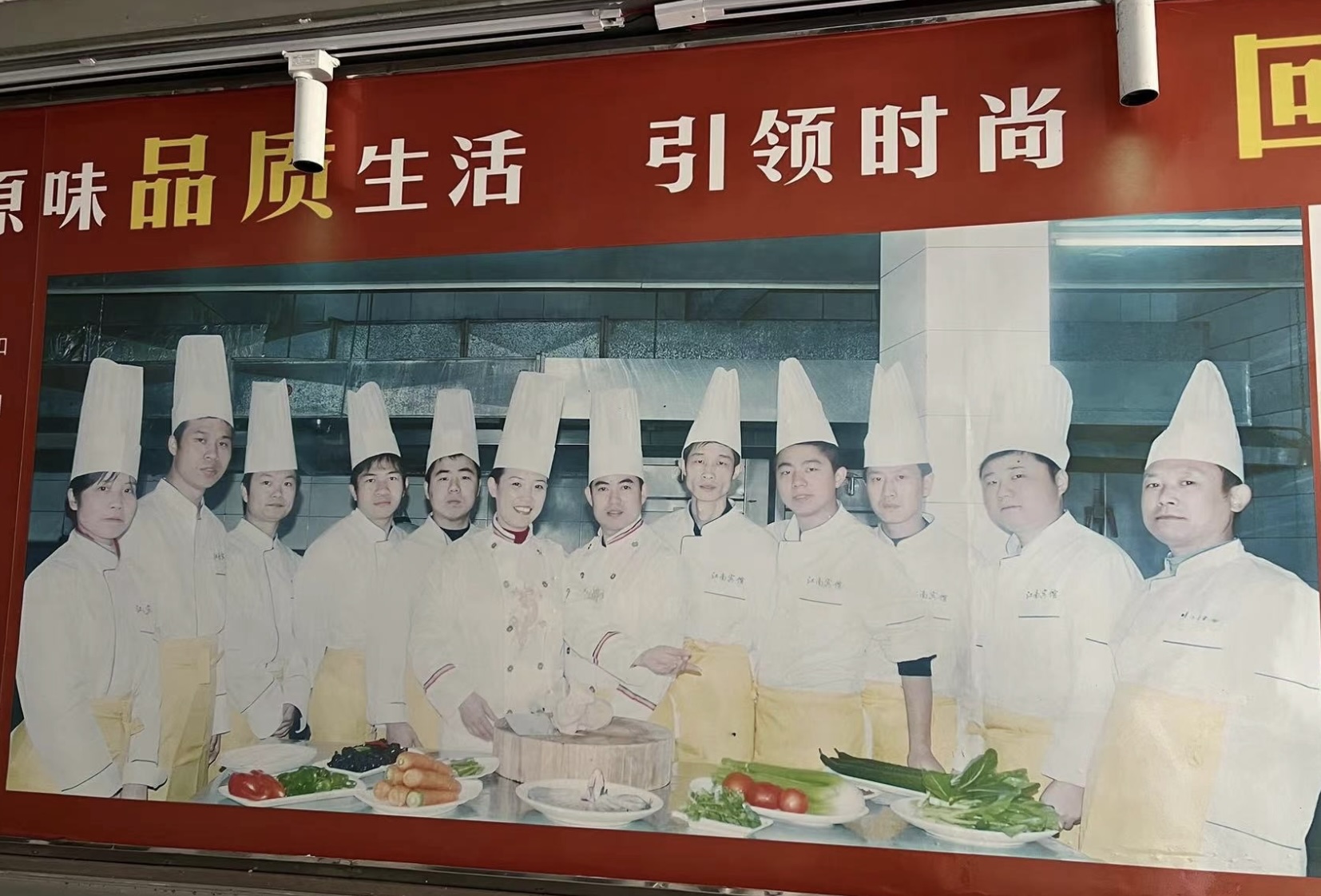
Jiangnan Hotel Chef Group Photo (Chen Zhangying sixth from left), 2004
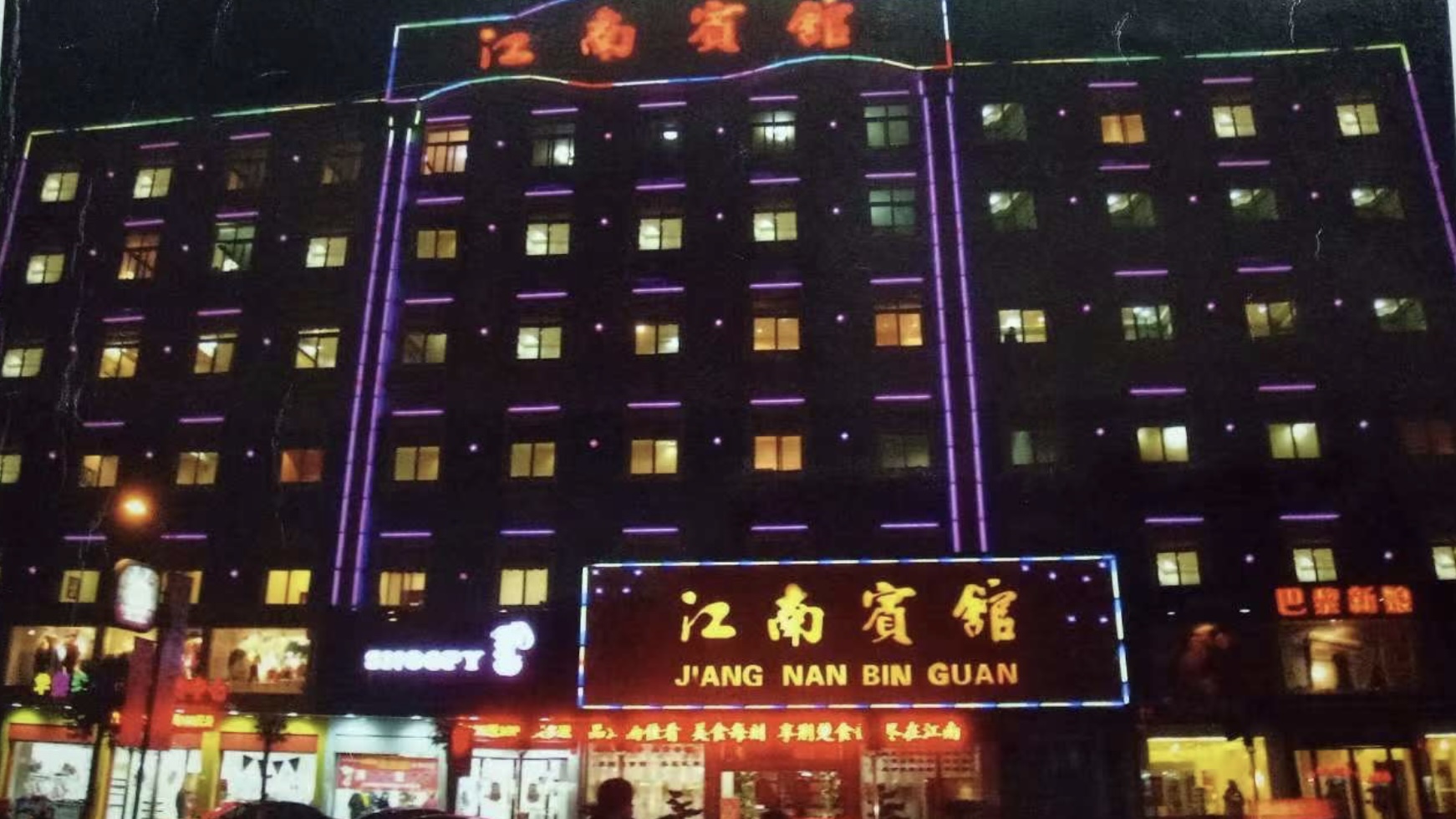
Jiangnan Hotel on a Summer Night, 2023
Chapter 4: Retiring at Age 64
Jiangnan has had three near-death experiences in his life, but each time he successfully pulled through with exceptional luck and strong willpower.
The first was when he was not yet 14, that serious work accident. While operating the cotton gin, his right forearm was severely damaged, causing comminuted fractures and leaving him disabled. Fortunately, his thin frame wasn’t completely swallowed by the machine, avoiding potentially fatal consequences.
The second was in spring 1985. At the time, Jiangnan was transporting cargo on the Yangtze River route. While passing the Wuhan Yangtze River Bridge, he encountered huge waves. In the extreme weather, he accidentally fell into the turbulent Yangtze. Due to his right-hand disability, he couldn’t maintain balance while swimming and struggled in the water for a long time. Fortunately, other crew members spotted him in time and rescued him with a bamboo pole. At the time, his wife was only a few months pregnant with their younger daughter—if Jiangnan had drowned, it would have been a tremendous disaster for their small family.
The third was in 2004, when Jiangnan suddenly went blind while investigating Sichuan cuisine and Chongqing hotpot business models in Chongqing. After visiting a nearby Chongqing hospital, doctors told him he might be permanently blind. He hurriedly ended his Chongqing trip and returned home to Gong’an County. Accompanied by family, he went to Jingzhou First People’s Hospital for further examination. Finally, doctors confirmed his blindness was caused by brain blood vessel blockage due to high blood lipids. After taking medication to lower blood lipids, his vision gradually returned to normal. Counting from October 28, 2004, Jiangnan experienced 12 days of blindness. At that time, Jiangnan Hotel had just opened for half a year and was still under the heavy pressure of 720,000 yuan in annual interest. When Jiangnan returned to Jiangnan Hotel with blind eyes, employees were filled with disappointment and panic—there were even rumors he had a terminal illness.
Jiangnan worried that due to his physical disability, his children might feel insecure. When his two daughters were young, he never let them see his disabled right hand. Only when the daughters grew older did Jiangnan reveal his hand condition to them.
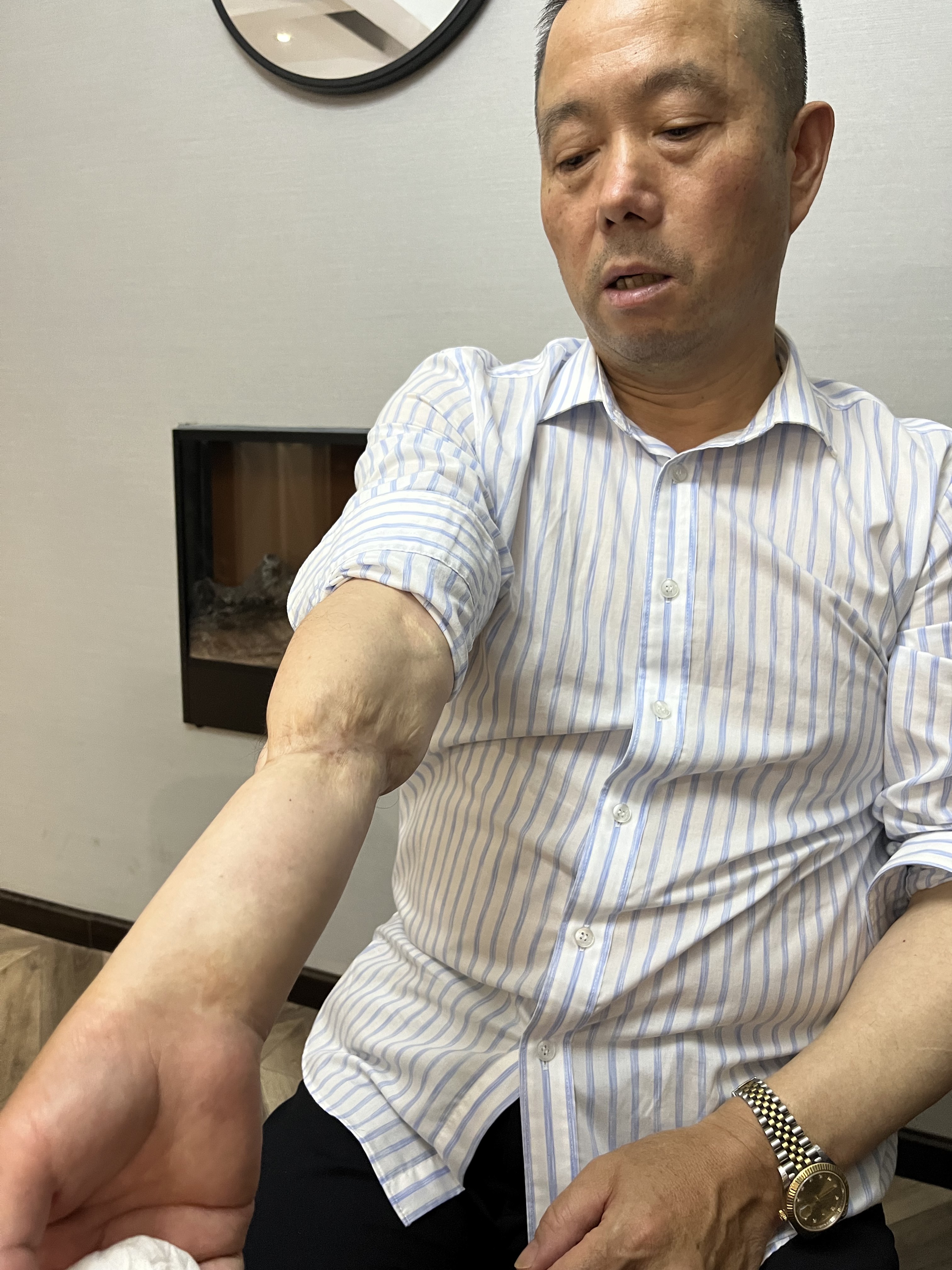
On Jiangnan Hotel’s opening day, Jiangnan was deeply moved and went alone to the hotel’s rooftop to cry for an hour. He was so moved because he felt he had accomplished something significant—an achievement none of his ancestors had attained. Someone once suggested he apply for a disability certificate to enjoy tax benefits, but Jiangnan believed he ran his business through wisdom and leadership, not needing to rely on a disability certificate. To this day, many people still haven’t noticed his right-hand disability. Even in scorching summer heat, he always wears long-sleeved shirts to cover his arm.
Gan Jiangnan Showing His Right Forearm, Summer 2023
Jiangnan made three important promises to his wife Chen Zhangying throughout their life together. The first promise was to save 400,000 yuan and purchase their own house. The second promise was to become a millionaire and ensure both daughters could attend university. The third promise was to become a multimillionaire and support both daughters through graduate school. This third promise gradually became reality after Jiangnan Hotel opened. Since Jiangnan owned the hotel’s land, he no longer needed to worry about landlords raising rent or losses from being unable to renew leases. Jiangnan Hotel was clearly positioned more upscale than his previous restaurants, adding guest room services beyond dining services. Notably, guest room business profit margins often far exceed those of dining.
Around 2011, Jiangnan gradually repaid all shareholders’ investment principal and interest, having these shareholders exit the company. He made this decision for several reasons: first, he didn’t want to continue bearing hundreds of thousands in annual interest; second, he preferred directing from behind the scenes rather than personally handling company daily affairs; third, he wanted his youngest sister’s husband Zhong Shengzhi to become Jiangnan Hotel’s general manager—if other shareholders existed, management appointments would require their approval. After 2011, Jiangnan Hotel’s daily operations were mainly handled entirely by Zhong Shengzhi, consulting Jiangnan only when needed.
On May 1, 2023, Jiangnan officially stepped down from the legal representative position, dissolved Jiangnan Hotel Limited Company, and leased Jiangnan Hotel’s operating rights to several senior employees to continue operations. This marked the end of Jiangnan’s entrepreneurial journey in the restaurant industry after 19 years of operating Jiangnan Hotel—his retirement from the business world.
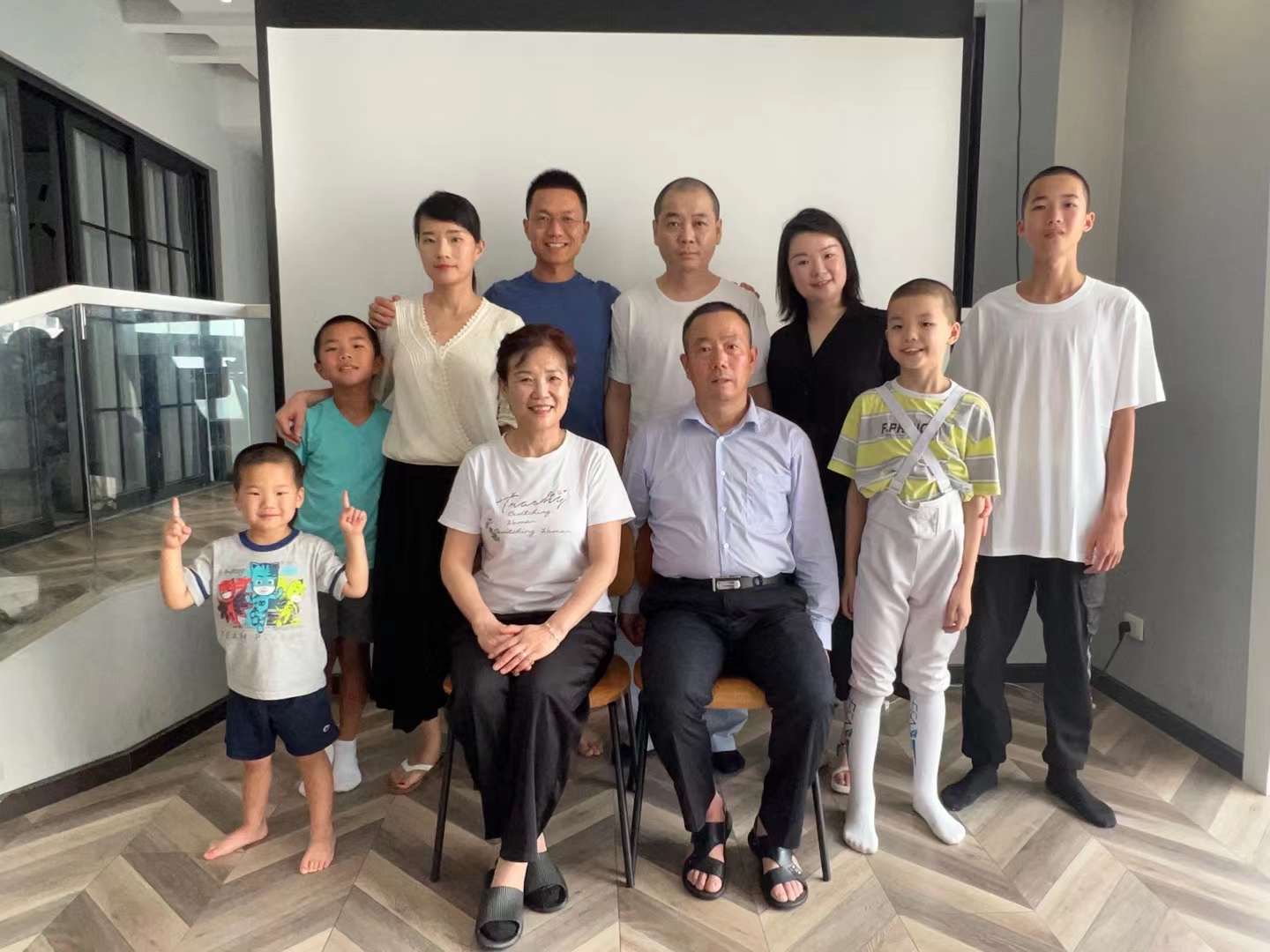
Gan Jiangnan with His Two Daughters, Sons-in-Law, and Four Grandchildren, Summer 2023
Acknowledgments
Thanks to my father-in-law Gan Jiangnan for sharing his story with me. Also thanks to my wife Gan Pingping for editing and improving this article.
Appendix
2003 interview video by Gong’an County TV: https://www.bilibili.com/video/BV14m4y1j7Nw
2006 Jiangnan Hotel introduction video: https://www.bilibili.com/video/BV1NV4y1q7xm